Building Intelligent Agent Applications with RAG + On-Device Inference
Combining Retrieval-Augmented Generation, local models, retrieval, and tool calling enables highly responsive, personalized apps that work without cloud dependencies.
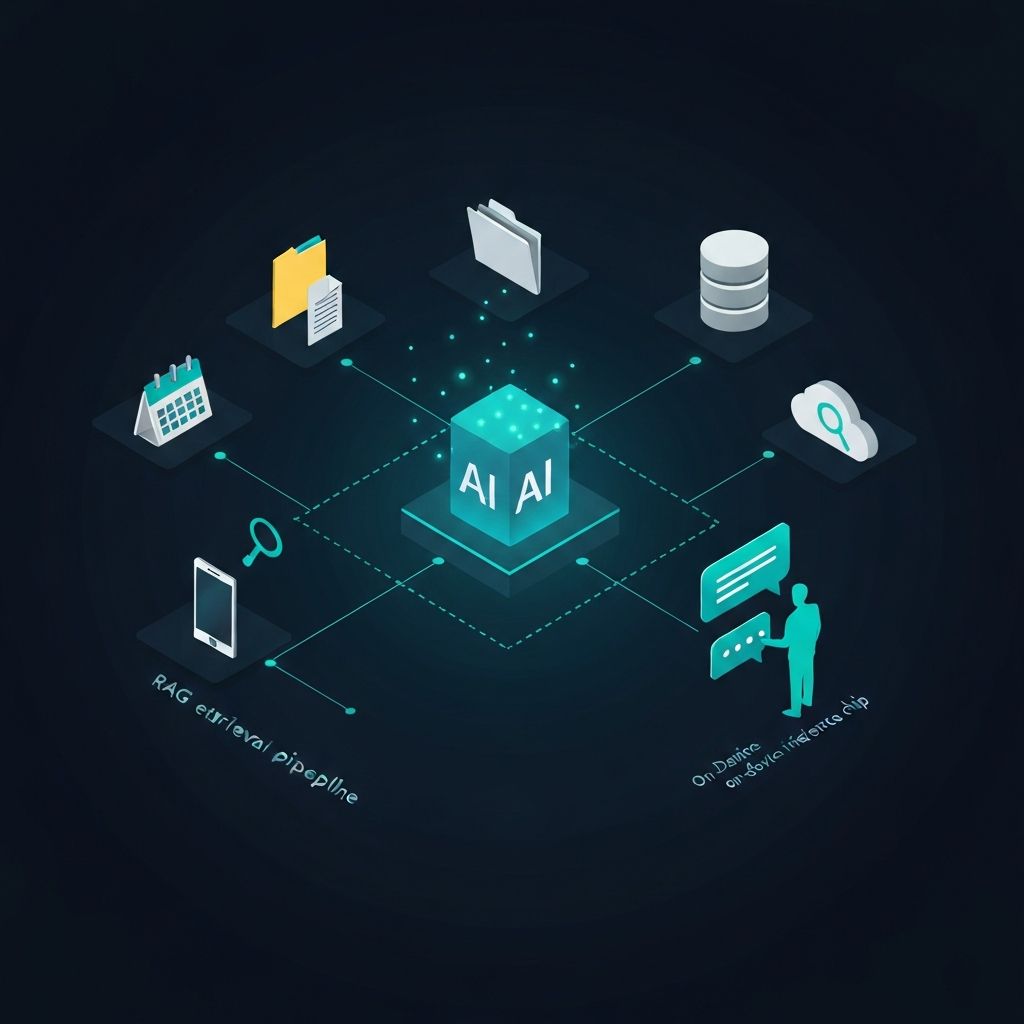
The Agent-First Architecture
An intelligent agent application is more than a chatbot. It is a system that can:
When this entire stack runs on-device, you get an agent that is fast, private, and works offline. This is the architecture we believe will define the next generation of mobile and desktop applications.
The Stack
A modern on-device agent application combines four layers:
1. Retrieval Layer (RAG)
The retrieval layer maintains a searchable index of relevant information:
When the user makes a request, the retrieval layer finds the most relevant context to ground the model's response.
2. Inference Layer (On-Device LLM)
Apple's Foundation Models or a locally-running model handles reasoning:
The key advantage of on-device inference is latency. A cloud round-trip adds 200-500ms minimum; on-device inference starts generating in under 100ms.
3. Tool Layer
Tools extend the agent's capabilities beyond text generation:
Apple's Foundation Models framework supports tool calling natively, making this integration straightforward.
4. Memory Layer
The memory layer maintains context across sessions:
This layered memory enables personalization that improves over time without sending data to a server.
Designing Agent Interactions
Good agent UX is fundamentally different from traditional app UX:
Proactive, not reactive — The agent should anticipate needs based on context. If it is Monday morning, surface the week's tasks without being asked.
Multimodal input — Support voice, text, and gesture input. Different contexts call for different interaction modes.
Transparent reasoning — When the agent takes an action, show why. "I moved your meeting because you mentioned you need preparation time" builds trust.
Graceful degradation — When the agent is unsure, it should say so clearly and offer alternatives rather than guessing.
Real-World Example: Voice Planner
Voice Planner, our upcoming iOS app, implements this full agent stack:
2. Retrieval: Finds the Johnson meeting details from calendar, previous notes, and related tasks
3. Reasoning: Determines the user needs preparation time, identifies current schedule constraints
4. Tool calling: Creates a preparation task, blocks time on the calendar, sets a reminder
5. Response: "I have added a 45-minute preparation block before your 2pm meeting with Johnson. I pulled up your notes from your last conversation with them."
All of this happens on-device, in under two seconds, with zero cloud dependencies.
Technical Architecture
For teams building agent applications, we recommend:
Start with a clear capability boundary — Define exactly what your agent can and cannot do. Unbounded agents are unreliable agents.
Invest in retrieval quality — The agent is only as good as the context it retrieves. Spend time on embedding quality, chunking strategies, and relevance ranking.
Design tool interfaces carefully — Each tool should have a clear schema, predictable behavior, and informative error states.
Test with real user patterns — Agent behavior is harder to test than deterministic code. Build evaluation suites based on real user interactions.
The Path Forward
We are at the beginning of the agent era. The hardware capabilities are here (Apple Silicon, Neural Engine), the APIs are maturing (Foundation Models, tool calling), and users are ready for more intelligent applications.
At IMAGIMATIC, we are building these systems now — both in our own products and for clients looking to modernize their applications with agent-first architectures.
Related Articles
Local AI + RAG Workflows on MacBooks and iPhones
Running Retrieval-Augmented Generation and lightweight models locally on Apple Silicon devices opens new possibilities for privacy-first, responsive AI applications.
What Are AI Coding Agents and Why They Matter in 2026
How AI coding assistants, vibe coding platforms, and autonomous dev agents are fundamentally changing software development workflows — and what engineering teams should do about it.